

Newspaper Article
'Captivating Revelation Of Witchcraft In Practice', Tom Dupree, Clarion-Ledger, 5 April 1970
- Historical date
- 1970
- Location
- Jackson, Mississippi, USA
- Category
- Newspaper Article
- People
- Alex Sanders, June Johns
- Source
- Newspapers.com
- Contributed by
- William Wallworth
- Added to the archive
About this item
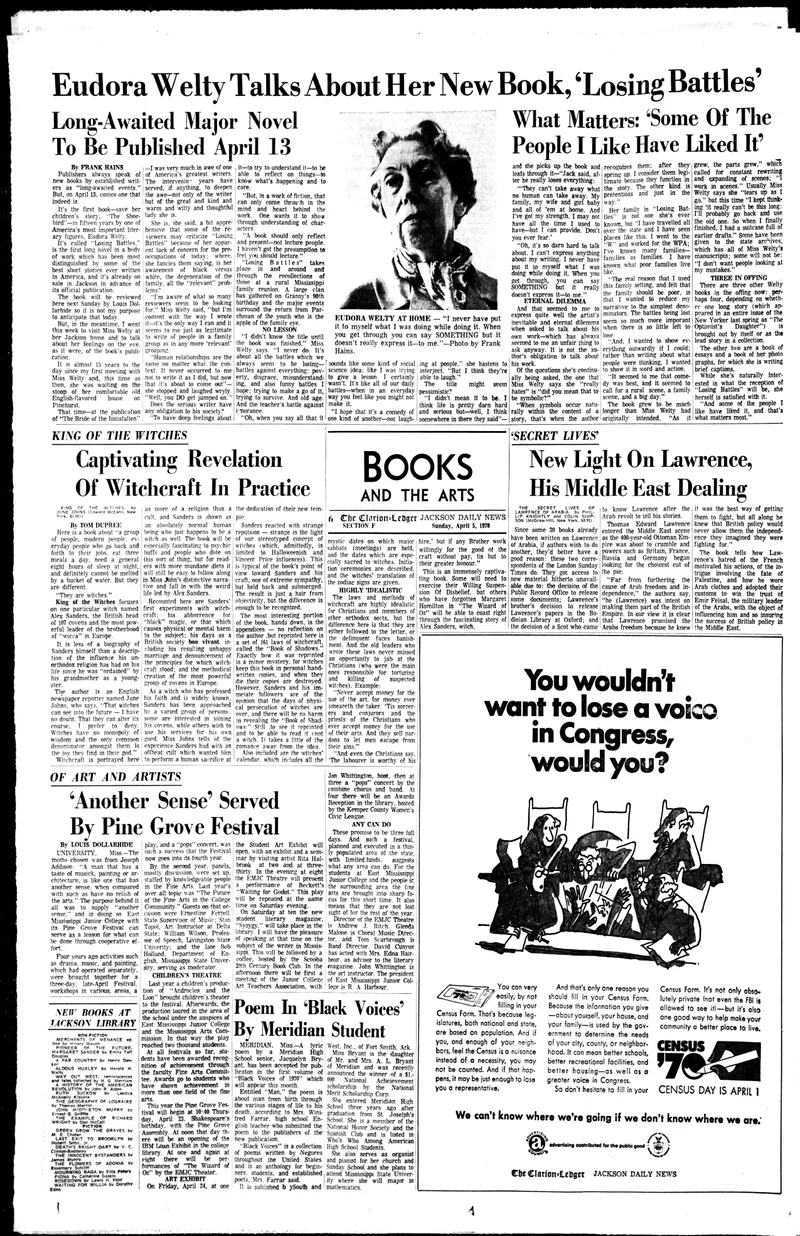
The Clarion-Ledger / Jackson Daily News (Jackson, Mississippi), Sunday 5 April 1970, Books and the Arts, section F page 6. Tom Dupree reviews the American edition of June Johns's King of the Witches (Coward-McCann, $5) and calls it "an immensely captivating book". He finds Alex Sanders shown as "an absolutely normal human being who just happens to be a witch as well", and thinks the appendices the most interesting part: the laws printed as the "Book of Shadows", which he is surprised to be able to read at all, the witches' calendar and the initiation rites. He quotes two of the laws on never taking money for the art. One of a run of American reviews in spring 1970 found by William Wallworth. Cropped to the review, with the full page alongside.
How to cite: Tom Dupree, 'King of the Witches: Captivating Revelation Of Witchcraft In Practice', Clarion-Ledger / Jackson Daily News, 5 April 1970, section F p. 6 (Newspapers.com page 67). Alexandrian Witchcraft Timeline & Archive.
Transcript
BOOKS AND THE ARTS
6 The Clarion Ledger JACKSON DAILY NEWS Section F Sunday, April 5, 1970
KING OF THE WITCHES
Captivating Revelation Of Witchcraft In Practice
KING OF THE WITCHES, by JUNE JOHNS (Coward McCann, New York, $5.00))
By TOM DUPREE
Here is a book about “a group of people, modern people, everyday people who go back and forth to their jobs, eat three meals a day, need a general eight hours of sleep at night, and definitely cannot be melted by a bucket of water. But they are different.
“They are witches.”
King of the Witches focuses on one particular witch named Alex Sanders, the British head of 107 covens and the most powerful leader of the brotherhood of “wicca” in Europe.
It is less of a biography of Sanders himself than a description of the influence his unorthodox religion has had on his life since he was “ordained” by his grandmother as a youngster.
The author is an English newspaper reporter named June Johns, who says, “That witches can see into the future - I have no doubt. That they can alter its course, I prefer to deny. Witches have no monopoly of wisdom and the only common denominator amongst them is the joy they find in their god.”
Witchcraft is portrayed here as more of a religion than a cult, and Sanders is shown as an absolutely normal human being who just happens to be a witch as well. The book will be especially fascinating to psychic buffs and people who dote on this sort of thing, but for readers with more mundane diets it will still be easy to follow along in Miss John's [sic] distinctive narrative and fall in with the weird life led by Alex Sanders.
Recounted here are Sanders’ experiments with witchcraft; his abhorrence for “black” magic, or that which causes physical or mental harm the subject; his days as a British society bon vivant, including his resulting unhappy marriage and denouncement of the principles for which witchcraft stood; and the methodical creation of the most powerful group of covens in Europe.
As a witch who has professed his faith and is widely known, Sanders has been approached by a varied group of persons: some are interested in joining his covens, while others wish to use his services for his own good. Miss Johns tells of the experience Sanders had with an offbeat cult which wanted him to perform a human sacrifice at the dedication of their new temple.
Sanders reacted with strange repulsion - strange in the light of our stereotyped concept of witches (which, admittedly, is limited to Halloweenish and Vincent Price influences). This is typical of the book’s point of view toward Sanders and his craft, one of extreme sympathy, but held back and submerged.
The result is just a hair from objectivity, but the difference is enough to be recognized.
The most interesting portion of the book, hands down, is the appendices - no reflection on the author ,but reprinted here is a set of 161 laws of witchcraft, called the “Book of Shadows.” Exactly how it was reprinted is a minor mystery, for witches keep this book in personal handwritten copies, and when they die their copies are destroyed. However, Sanders and his imme[d]iate followers are of the opinion that the days of physical persecution of witches are over, and there will be no harm in revealing the “Book of Shadows.” Still, to see it reprinted and to be able to read it (not a witch, I) takes a little of the romance away from the idea.
Also included are the witches’ calendar, which includes all the mystic dates on which major sabbats (meetings) are held, and the dates which are especially sacred to witches. Initiation ceremonies are described, and the witches’ translation of zodiac signs are given.
HIGHLY ’IDEALISTIC
The laws and methods of witchcraft are highly idealistic for Christians and members of other orthodox sects, but the difference here is that they are either followed to the letter, or the delinquent faces banishment. And the old leaders who wrote these laws never missed an opportunity to jab at the Christians (who were the main ones responsible for torturing and killing of suspected witches). Example:
“Never accept money for the use the art, for money ever smeareth the taker. ‘Tis sorcerers and conjurors and the priests of the Christians who ever accept money for the use of their arts. And they sell pardons to let men escape from their sins.”
“And even the Christians say, ‘The labourer is worthy of his hire,’ but if any Brother work willingly for the good of the craft without pay, tis but to their greater honour.”
This is an immensely captivating book. Some will need to exercise their Willing Suspension Of Disbelief, but others who have forgotten Margaret Hamilton in “The Wizard of Oz” will be able to coast right through the fascinating story of Alex Sanders, witch.
Suggest a correction
Spotted a mistake, or read the handwriting differently? Offer a corrected transcript.
Log in or create a free account to transcribe this item
No comments yet