


Newspaper Article
'King of the Witches' review, Geraldine Lewis, Oregon Daily Journal, 28 March 1970
- Historical date
- 1970
- Location
- Portland, Oregon, USA
- Category
- Newspaper Article
- People
- Alex Sanders, June Johns
- Source
- Newspapers.com
- Contributed by
- William Wallworth
- Added to the archive
About this item
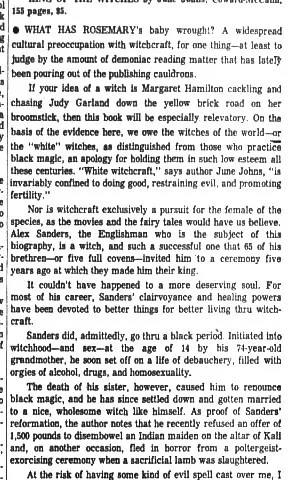
The Oregon Daily Journal (Portland), 28 March 1970, page 11, in the Bookmark column. Geraldine Lewis finds King of the Witches a book "with the ring of authenticity" among much "sheer nonsense" on witchcraft. She describes Alex as initiated at seven after stumbling on one of his grandmother's ceremonies, turning to black witchcraft after her death, then pledging himself to witchcraft "as a benign and benevolent religion", and praises the book's look at the personal side of the Craft. Other reviews in the column are not transcribed.
How to cite: Geraldine Lewis, review of King of the Witches, Bookmark, The Oregon Daily Journal, 28 March 1970, p. 11. Alexandrian Witchcraft Timeline & Archive.
Transcript
Bookmark
[Several books are reviewed; only the review of King of the Witches is transcribed.]
KING OF THE WITCHES by June Johns; Coward McCann; 154 pages; $5.
There is a lot being printed these days about witchcraft, and a lot of it seems like sheer nonsense; but here is a book with the ring of authenticity. It is the story of Alex Sanders, elected head of most if not all of the covens in Europe.
Alex Sanders is a hereditary witch, initiated into the craft by his grandmother when he was seven years old. This was a tender age for initiation, but his grandmother didn't plan it that way. He accidently stumbled in on one of her ceremonies, and she decided it was a good enough time to swear him in and put a bond of secrecy on him. From then on she taught him the ancient chants and rituals of the craft and how to develop his mental powers. It was after her death, when he could find no other witches to work with, that he broke the old law against working alone and using the power for himself and turned to black witchcraft.
White witchcraft, says Alex Sanders, is used only for good. For the good of the petitioner or of someone he wishes to help. Black witchcraft is evil and is done to harm someone. It may bring material reward to the witch who practices it, but always results in personal tragedy. In this book he tells why he succumbed to its temptations, the years he wasted in its use, and the hard climb back to goodness. He pledged himself thereafter to the use and teaching of witchcraft as a benign and benevolent religion.
Much already has been written about the history of the craft of the Wicca (a word which means wise ones), but this book deals with the personal, human aspects. Why does anyone in our predominantly Christian culture turn to witchcraft, and how do people feel about it when it is their chosen religion? For it is a religion, the oldest one in the world, older than Christianity by several thousand years. Many of its chants and rituals are so old their exact meaning is unknown. Here we are given vivid pictures of Alex and his fellow witches using their art to “bring down the power” and harness it for their use. The power they speak of is a mental force which they believe comes from the godhead and is a part of man.
A fascinating look at the psychology and emotions behind an unusual religion, one to which an increasing number of people are turning. - Geraldine Lewis.
Suggest a correction
Spotted a mistake, or read the handwriting differently? Offer a corrected transcript.
Log in or create a free account to transcribe this item

No comments yet