
Newspaper Article
'Where witches gather', June Johns, Liverpool Daily Post, 9 February 1968
- Historical date
- 1968
- Location
- Cheshire-Lancashire border
- Category
- Newspaper Article
- People
- June Johns, Alex Sanders
- Source
- British Newspaper Archive
- Contributed by
- William Wallworth
- Added to the archive
About this item
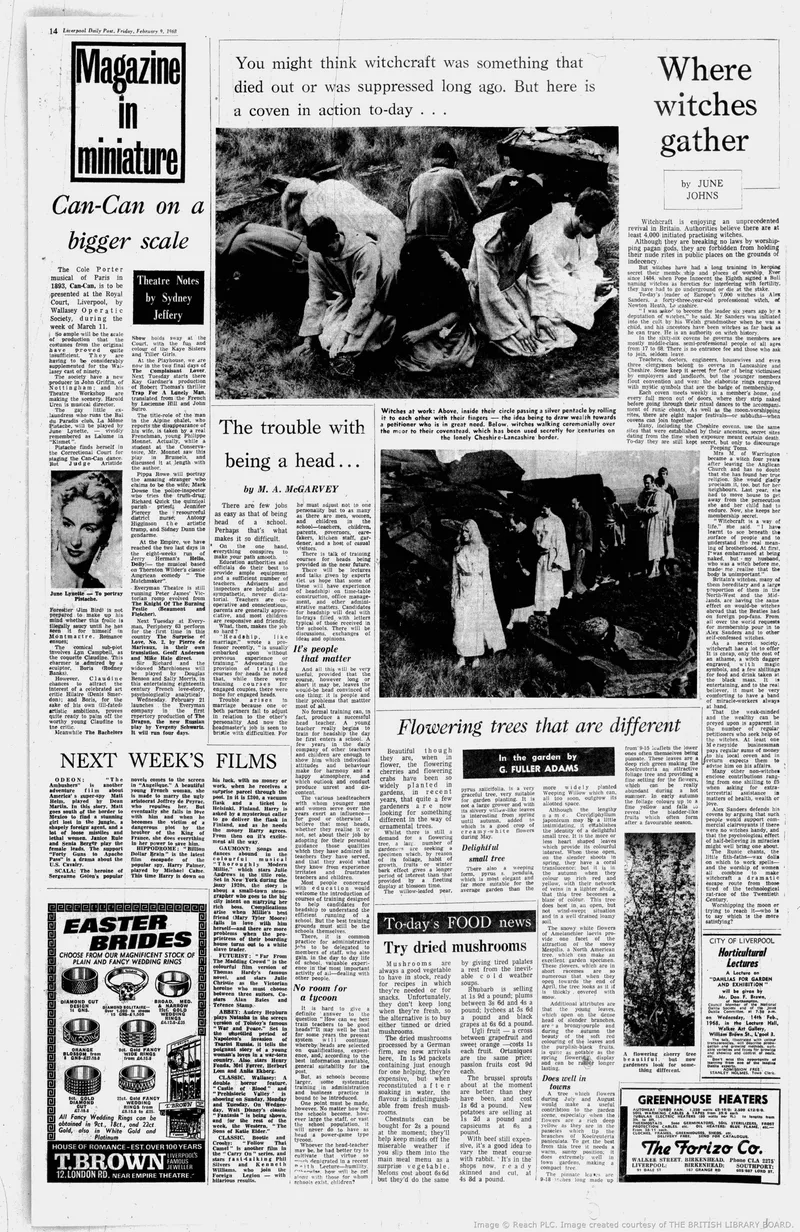
Liverpool Daily Post, Friday 9 February 1968, page 14. A feature by June Johns, whose biography of Sanders, King of the Witches, was published the following year. She puts Britain's initiated witches at 4,000 at least and calls Alex Sanders, 43, of Newton Heath, the leader of Europe's 7,000, governing 66 covens whose members include teachers, doctors, engineers and three clergymen. He was initiated as a child by his Welsh grandmother. The piece describes weekly meetings in members' homes, nude rites out of doors at the full moon, and a Mrs M. of Warrington who had to move house to escape persecution. Johns is sceptical of the petitioners who send the witches money for help with health, wealth or love.
Illustrated with two photographs: witches inside their circle rolling a silver pentacle between them to draw wealth to a petitioner in need, and a robed procession walking over the moor to their covenstead on the Cheshire-Lancashire border. The archive also holds moorland photographs of the coven taken by Jack Smith, June Johns's husband, for her book.
How to cite: June Johns, 'Where witches gather', Liverpool Daily Post, 9 February 1968, p. 14. Alexandrian Witchcraft Timeline & Archive.
Transcript
You might think witchcraft was something that died out or was suppressed long ago. But here is a coven in action to-day….
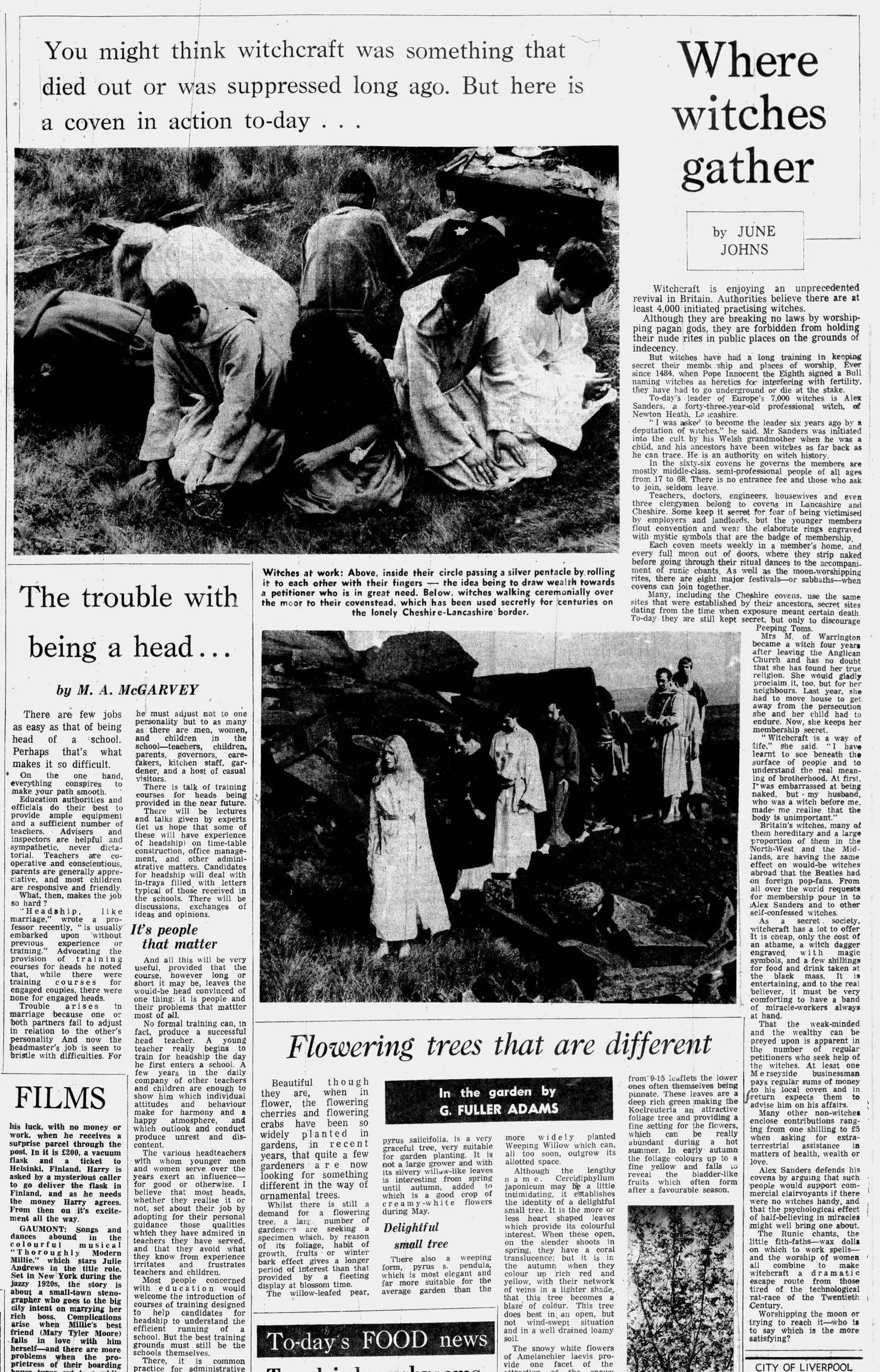
[Photograph]
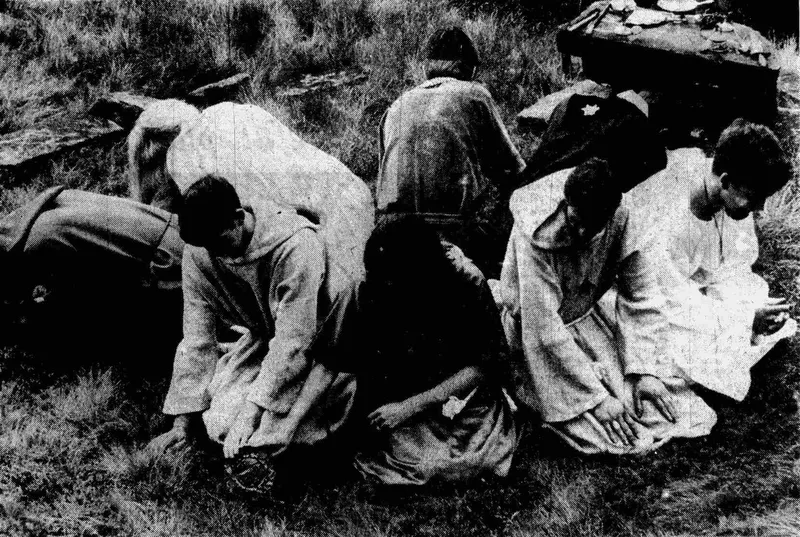
Witches at work: Above, inside their circle passing a silver pentacle by rolling it to each other with their fingers - the idea being to draw wealth towards a petitioner who is in great need. Below, witches walking ceremonially over the moor to their covenstead, which has been used secretly for centuries on the lonely Cheshire-Lancashire border.
[Photograph]
Where witches gather
by JUNE JOHNS
Witchcraft is enjoying an unprecedented revival in Britain. Authorities believe there are at least 4000 initiated practising witches.
Although they are breaking no laws by worshipping pagan gods, they are forbidden from holding their nude rites in public places on the grounds of indecency.
But witches have had a long training in keeping secret their membership and places of worship. Ever since 1484, when Pope Innocent the Eighth signed a Bull naming witches as heretics for interfering with fertility, they have had to go underground or die at the stake.
To-day’s leader of Europe’s 7000 witches is Alex Sanders, a forty-three-year-old professional witch, of Newton Heath, Lancashire.
“I was asked to become the leader six years ago by deputation of witches,” he said. Mr Sanders was initiated into the cult by his Welsh grandmother when he was a child, and his ancestors have been witches as far back as he can trace. He is an authority on witch history.
In the sixty-six covens he governs the members are mostly middle-class, semi-professional people of all ages from 17 to 68. There is no entrance fee and those who ask to join, seldom leave.
Teachers, doctors, engineers, housewives and even three clergymen belong to covens in Lancashire and Cheshire. Some keep it secret for fear of being victimised by employers and landlords, but the younger members flout convention and wear the elaborate rings engraved with mystic symbols that are the badge membership.
Each coven meets weekly in a member's home and every full moon out of doors, where they strip naked before going through their ritual dances to the accompaniment of runic chants. As well as the moon-worshipping rites, there are eight major festivals - or Sabbaths - when covens can join together.
Many, including the Cheshire covens use the same sites that were established by their ancestors, secret sites dating from the time when exposure meant certain death. To-day they are still keep secret, but only to discourage Peeping Toms.
Mrs M. of Warrington became a witch four years after leaving the Anglican Church and has no doubt that she has found her true religion. She would gladly proclaim it, too, but for her neighbours. Last year, she had to move house to get away from persecution, she and her child had to endure. Now, she keeps her membership secret.
“Witchcraft is a way of life,” she said. “I have learnt to see beneath the surface people and to understand the real meaning of brotherhood. At first. I was embarrassed at being naked, but my husband, who was a witch before me, made me realise that the body is unimportant.”
Britain’s witches, many of them hereditary and a large proportion of them in the North-West and Midlands, are having the same effect on would-be witches abroad that the Beatles had on foreign pop-fans. From all over the world requests for membership pour in to Alex Sanders and to other self-confessed witches.
As a secret society, witchcraft has a lot to offer[.] It is cheap, only the cost of an athame. a witch dagger engraved with magic symbols, and a few shillings for food and drink taken at the black mass. It is entertaining, and to the real believer, it must be very comforting to have a hand of miracle-workers always at hand.
That the weak-minded and the wealthy can be preyed upon is apparent in the number of regular petitioners who seek help of the witches. At least one Merseyside businessman pays regular sums of money to his local coven and in return expects them to advise him on his affairs.
Many other non-witches enclose contributions ranging from one shilling to £5 when asking for extraterrestrial assistance in matters of health. Wealth or love.
Alex Sanders defends his covens by arguing that such people would support commercial clairvoyants if there were no witches handy. and that the psychological effect of half-believing in miracles might well bring one about.
The Runic chants. the little fith-faths - wax dolls on which to work spells - and the worship of women all combine to make witchcraft a dramatic escape route from those tired of the technological rat-race of the Twentieth Century.
Worshipping the moon or trying to reach it - who is to say which is the more satisfying?
Suggest a correction
Spotted a mistake, or read the handwriting differently? Offer a corrected transcript.
Log in or create a free account to transcribe this item
No comments yet