

Newspaper Article
'Witchcraft with a touch of pantomime', Kevin Dowling, Manchester Evening News, 29 October 1969
- Historical date
- 1969
- Location
- Manchester
- Category
- Newspaper Article
- People
- Alex Sanders, June Johns
- Source
- Newspapers.com
- Contributed by
- William Wallworth
- Added to the archive
About this item
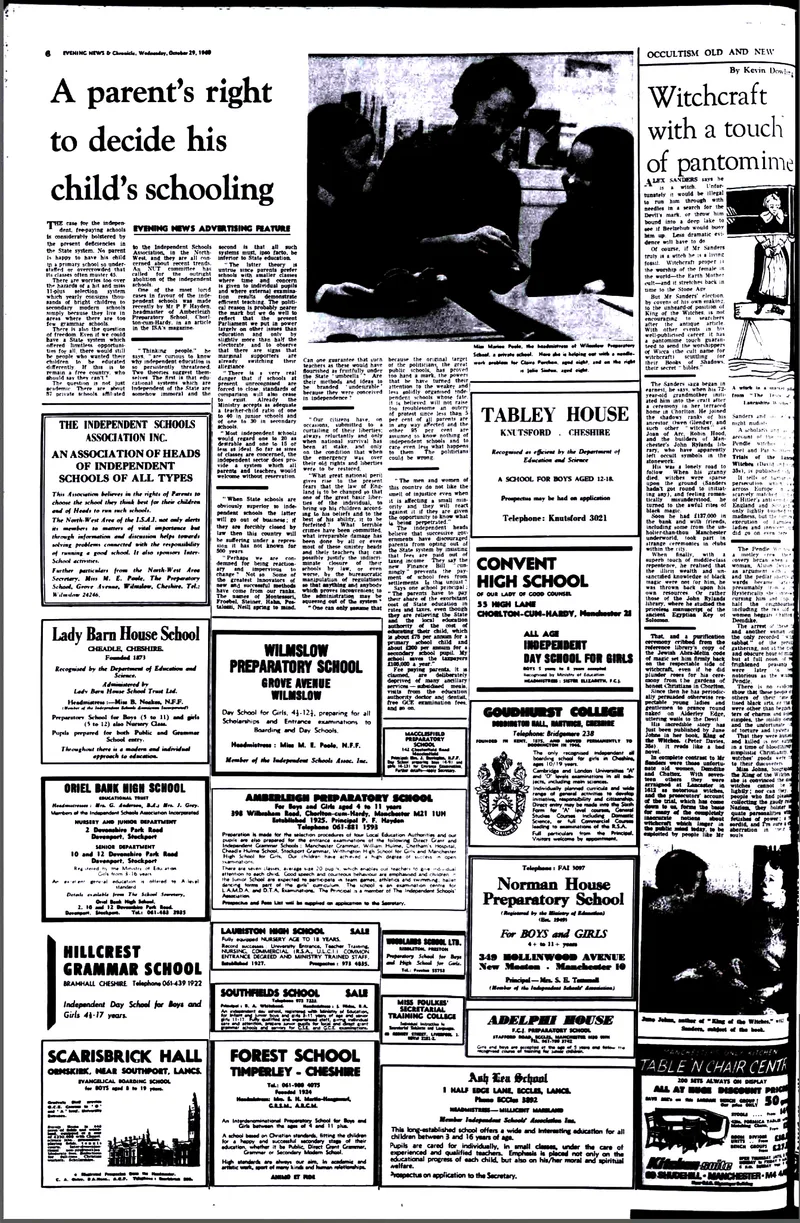
Manchester Evening News, Wednesday 29 October 1969, page 6. Kevin Dowling's hostile double review, under the heading 'Occultism old and new', of June Johns's King of the Witches and of The Trials of the Lancashire Witches by Edgar Peel and Pat Southern, both published that week. He mocks Sanders's election as King of the Witches 'by covens of his own making', retells the book's story of his grandmother's initiation in Chorlton, the £137,000 he is said to have made through black magic, and his study of the Key of Solomon and the Abra-Melin system at the John Rylands library, and says the book 'reads like a bad novel'. The second half sets Sanders against the Pendle witches of 1612, Demdike and Chattox.
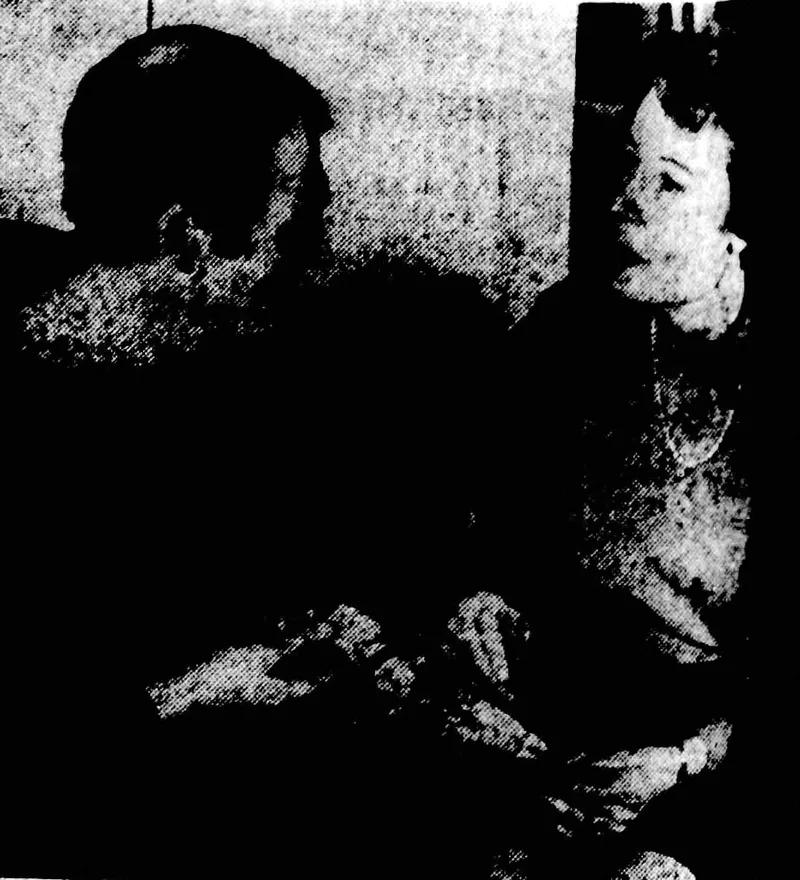
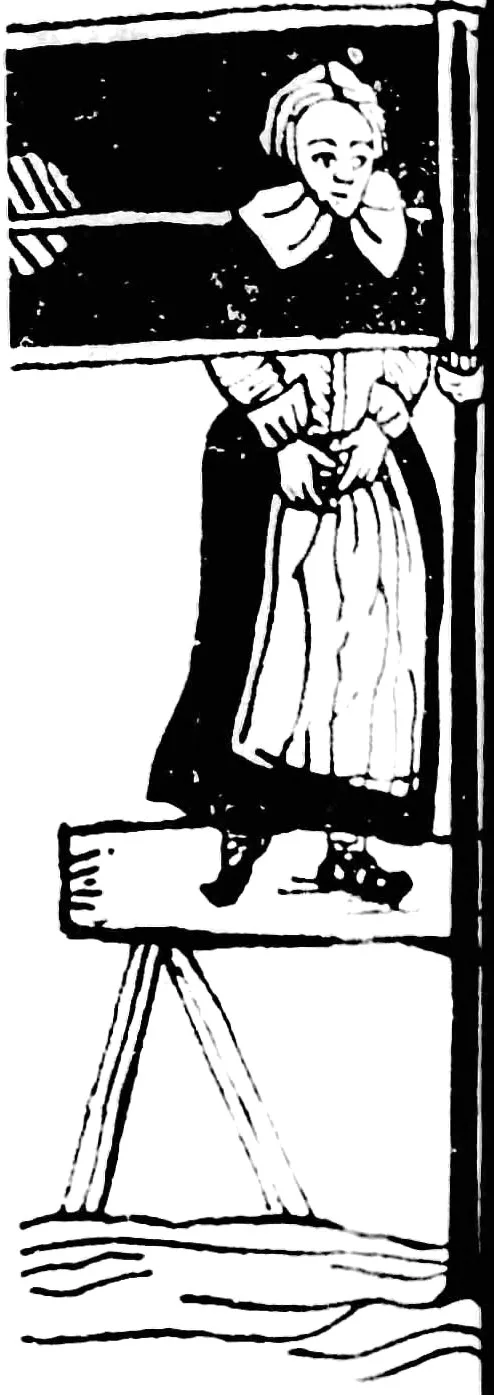
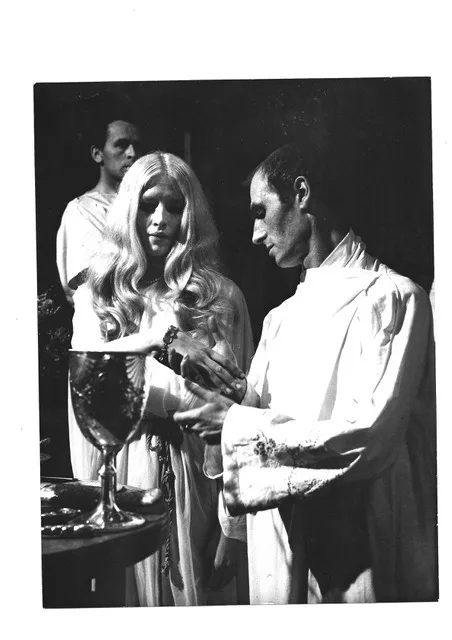
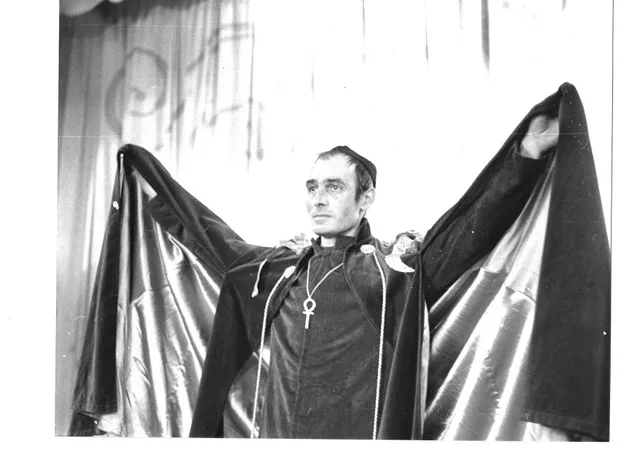
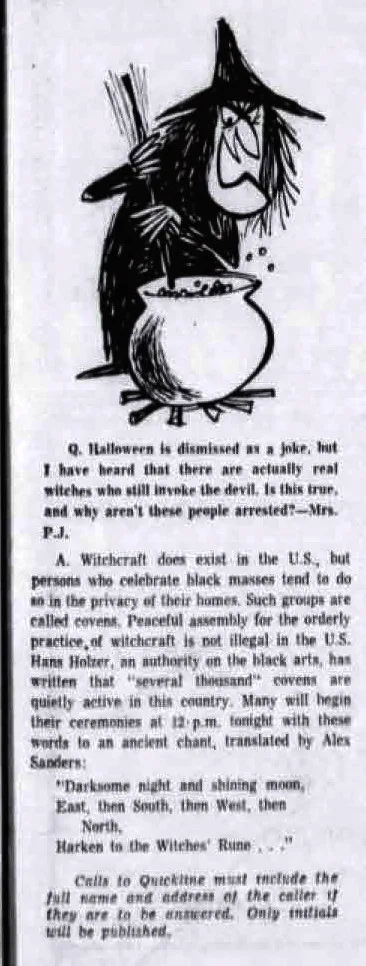
Illustrated with a woodcut of a witch in a pillory from the Lancashire book, and a photograph of June Johns with Alex Sanders. The right-hand edge of the column is lost in the binding of the scanned volume, so parts of the second half are incomplete.
How to cite: Kevin Dowling, 'Witchcraft with a touch of pantomime', Manchester Evening News, 29 October 1969, p. 6. Alexandrian Witchcraft Timeline & Archive.
Transcript
OCCULTISM OLD AND NEW
By Kevin Dowling
Witchcraft with a touch of pantomime
ALEX SANDERS says he is a witch. Unfortunately it would be illegal to run him through with needles in a search for the Devil’s mark, or throw him bound into a deep lake to see if Beelzebub would buoy him up. Less dramatic evidence will have to do.
Of course, if Mr Sanders truly is a witch he is a living fossil. Witchcraft proper is the worship of the female in the world - the Earth Mother cult- and it stretches back in time to the Stone Age.
But Mr Sanders’ election, by covens of his own making, to the unheard-of position of King of the Witches, is not encouraging to searchers after the antique article. With other events in his well-publicised career, it has a pantomime touch guaranteed to send the worshippers of Wicca (the cult name for witchcraft) scuttling for their Books of Shadows, their secret “bibles.”
The Sanders saga began in earnest, he says, when his 72- year-old grandmother initiated him into the craft after a ceremony in her terraced home in Chorlton. He joined the shadowy ranks of his ancestor, Owen Glendwr, and such other “witches” as Joan of Arc, Robin Hood, and the builders of Manchester’s John Rylands library, who have apparently left occult symbols in the stonework.
His was a lonely road to follow. When his granny died, witches were sparse upon the ground (Sanders hadn’t got round to initiating any), and feeling romantically misunderstood, he turned to the awful rites of black magic.
Soon he had £137,000 in the bank and with friends, including some from the unholier-than-thou Manchester underworld, took part in strange ceremonies in clubs within the city.
When finally, with a superb touch of middle-class repentence, realised that the illicit wealth unsanctified knowledge of black magic were not for him, he was thrown back upon his own resources. Or rather those of the John Rylands library, where he studied the priceless manuscript of the ancient Egyptian Key of Solomon.
That, and a purification ceremony cribbed from the reference library's copy of the Jewish Abra-Melin code of magic set him firmly back on the respectable side of witchcraft, even if he did plunder roses for his ceremony from the gardens of honest Christians in Chorlton.
Since then he has periodically persuaded otherwise respectable young ladies and gentlemen to prance round naked on Alderley Edge, uttering wails to the Devil.
His incredible story has just been published by June Johns in her book, King of the Witches. (Peter Davies, 35s). it reads like a bad novel.
In complete contrast to Mr Sanders were those unfortunate old women, Demdike and Chattox. With seventeen others they were arraigned at Lancaster in 1612 as notorious witches, and the prosecutors’ account of the trial, which has come down to us, forms the basis for many of the completely inaccurate notions about witchcraft which linger in the public mind today, to be exploited by people like Mr Sanders and his fellow [mid?] night nudist.
[From here the right-hand edge of the column is lost in the binding of the scanned volume. Gaps are marked [-].]
A scholarly and fascinat[ing] account of the trial of [the] Pendle witches by Ed[?] Peel and Pat Southern. [-] Trials of the Lancas[shire] Witches (David and Cha[-] 35s), is published today.
It tells of barbarism persecution which sw[ept?] across Europe on a [-] scarcely matched till the [-] of Hitler's anti-semitic [-] England and Scotland [-] only lightly touched by [-] madness, but the torture [and] execution of harmless [men] ladies and innocent child[ren] did go on even here.
The Pendle Witches w[as] a motley crew; their covery began when a yo[ung] woman, Alizon Device, [-] an argument with a pe[dlar] and the pedlar shortly af[ter]wards became paralysed presumably from a st[oke?]. Hysterically she confessed cursing him and implica[-] half the neighbourhood including the two old [-] women beggars, Chattox [-] Demdike.
The arrest of these [-] and another woman led [-] the only recorded “witch sabbat” of the period, gathering, not at the dis[-] and obscure hour of midn[ight] but at full noon, of [-] frightened peasants [who] were later to be[-] notorious as the witches [-] Pendle.
There is no evidence [-] show that these people o[r] others of their time p[ac]tised black arts, or that [-] were other than beggars [-]ters of charms and sellers [-] simples, the mildly deran[ged] and the unfortunate vic[-] of torture and hysteria.
That they were hunted and killed is not surp[risng] in a time of bloodthirsty simplistic Christianity, [-] witches’ goods were [-] to their discoverers.
Miss Johns, biographer [-] the King of the Witches, [-] she is convinced the mod[ern] witches cannot be ta[ken] lightly; nor can they, [-] people who find pleasure collecting the gaudy reli[cts] [-] Nazism, they bolster quate personalities with fetishes of power; a ra[ther] sordid, and I'm sure a c[-] aberration in their [-] souls.
[Illustration]
A witch in a market pillo[ry] from “The Trials of [the] Lancashire Witches.”
[Photograph]
June Johns, of “King the Witches,” with A[lex] Sanders, subject of the book.
Suggest a correction
Spotted a mistake, or read the handwriting differently? Offer a corrected transcript.
Log in or create a free account to transcribe this item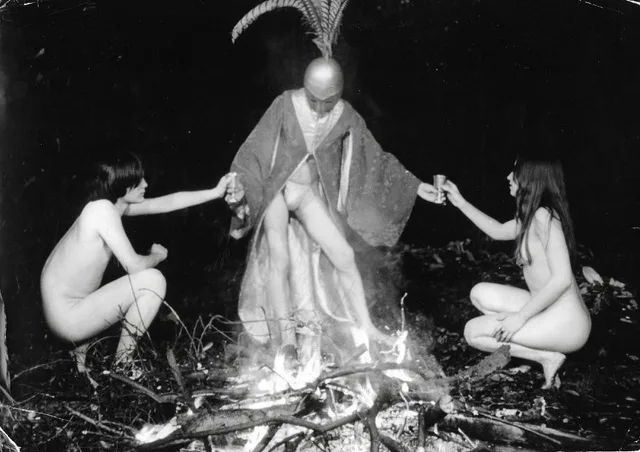


No comments yet