
Typed Notes
Typed Document - King Arthur and the Sword
- Historical date
- Date Unknown
- Location
- Unknown
- Category
- Typed Notes
- People
- King Arthur
- Source
- Museum/archive
- Added to the archive
About this item
A document outlining the story of King Arthur and the sword in which it was determined who shall be king.
Transcript
6947
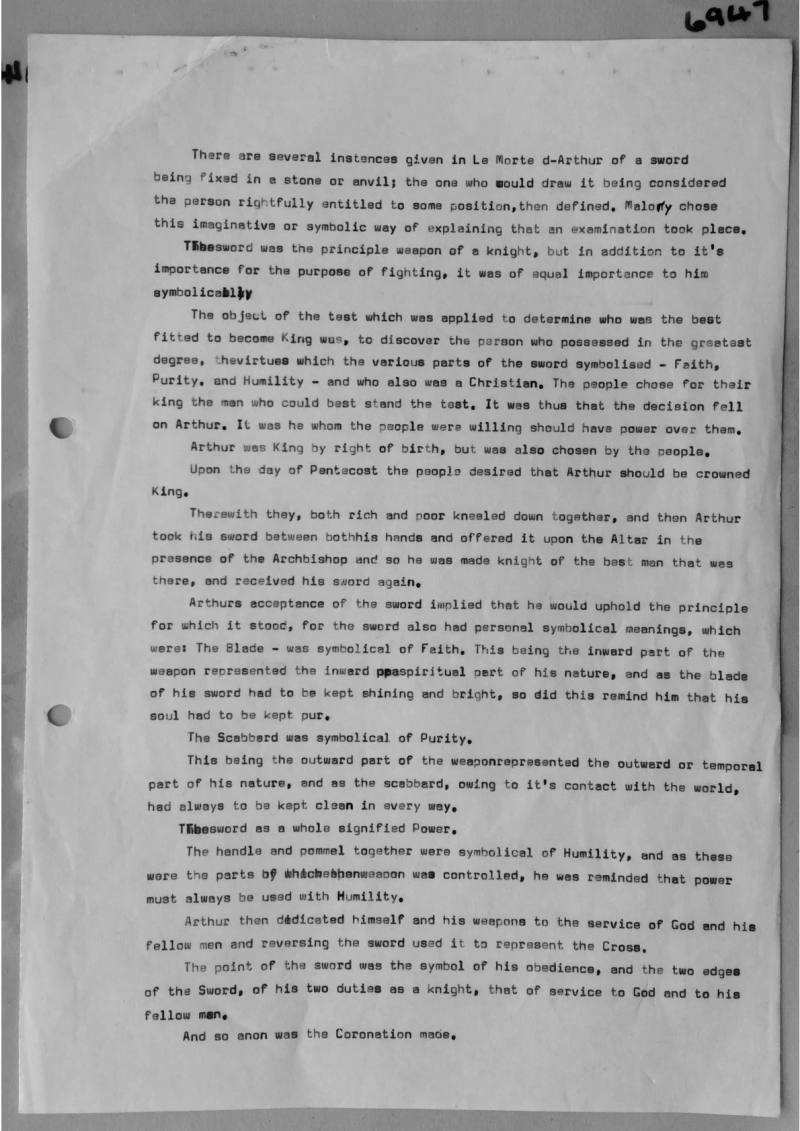
There are several instances given in Le Morte d'Arthur of a sword being fixed in a stone or anvil; the one who would draw it being considered the person rightfully entitled to some position, then defined. [Malory?] chose this imaginative or symbolic way of explaining that an examination took place.
The sword was the principle weapon of a knight, but in addition to it's importance for the purpose of fighting, it was of equal importance to him symbolically.
The object of the test which was applied to determine who was the best fitted to become King was, to discover the person who possessed in the greatest degree, the virtues which the various parts of the sword symbolised — Faith, Purity, and Humility — and who also was a Christian. The people chose for their king the man who could best stand the test. It was thus that the decision fell on Arthur. It was he whom the people were willing should have power over them.
Arthur was King by right of birth, but was also chosen by the people.
Upon the day of Pentecost the people desired that Arthur should be crowned King.
Therewith they, both rich and poor, kneeled down together, and then Arthur took his sword between both his hands and offered it upon the Altar in the presence of the Archbishop, and so he was made knight of the best man that was there, and received his sword again.
Arthur's acceptance of the sword implied that he would uphold the principle for which it stood, for the sword also had personal symbolical meanings, which were: The Blade — was symbolical of Faith. This being the inward part of the weapon represented the inward [illegible] spiritual part of his nature, and as the blade of his sword had to be kept shining and bright, so did this remind him that his soul had to be kept pure.
The Scabbard was symbolical of Purity.
This being the outward part of the weapon, represented the outward or temporal part of his nature, and as the scabbard, owing to it's contact with the world, had always to be kept clean in every way.
The sword as a whole signified Power.
The handle and pommel together were symbolical of Humility, and as these were the parts by [illegible] the weapon was controlled, he was reminded that power must always be used with Humility.
Arthur then dedicated himself and his weapons to the service of God and his fellow men, and reversing the sword, used it to represent the Cross.
The point of the sword was the symbol of his obedience, and the two edges of the Sword, of his two duties as a knight, that of service to God and to his fellow man.
And so anon was the Coronation made.
Notes:
- "Le Morte d'Arthur" is Thomas Malory's 15th-century compilation of Arthurian legend, first printed in 1485 — the text this document draws its interpretation from.
- This document reads as an instructional/explanatory essay analysing the symbolism of the sword-in-the-stone story, rather than a personal narrative, trance record, or letter.
Authorship note:
This document contains no first-person narrator and no diarist framing — it reads as an impersonal teaching/essay text throughout. Authorship cannot be determined from internal voice the way it can for the trance notes and letters elsewhere in this collection; it is plausibly Alex Sanders' own teaching material (consistent with other instructional documents in the archive, e.g. mow1416i1.jpg), but this is an inference from context rather than direct textual evidence.
Suggest a correction
Spotted a mistake, or read the handwriting differently? Offer a corrected transcript.
Log in or create a free account to transcribe this item
No comments yet